

A Healthy Dose of Fear
An Adventure in Colombia's Ciudad Perdida

During my travels, the person who experienced the most fear wasn’t me, but my mother. Only now am I realizing the strain I put my family under as I went off gallivanting around the world. While I was out having adventures, my loved ones were at home, not having nearly as much fun.
I tried my best to keep close friends and family informed. For instance, I sent Mom a detailed spreadsheet every few days with updates on where I was going to stay and how long it would take me to get there.
Unfortunately, many of the columns were filled with generic descriptions, like “public bus from Cartagena to Santa Maria.” Not only did my mother not know where these places were (she did generally, but not specifically), but she was also left with the knowledge that I was taking public transportation around Colombia, which was, at the time, under U.S. government travel warnings. So, partial information was perhaps causing more worry than no information at all.
Ignoring the Warnings
During this particular 6-month stint traveling around South America, I was actually paying closer attention to government travel warnings than usual. My radar was up mainly because I was beginning to feel some disbelief that I had made it through this big 2-year adventure relatively unscathed. I had the inkling that my number was somehow up; that my luck was running out. Not a good feeling to have.
As I mentioned, the system I had for keeping my loved ones informed was imperfect. This became painfully clear when one of my updates didn’t get through. Unfortunately, this occurred in Colombia, which was known at the time for hostage taking.
The U.S. government had deemed the corridor between Bogota and Cartagena safe for Americans to travel—if you took normal precautions, of course. And I stuck to these parameters when touring the country. Almost.
Trekking into the Danger Zone
That is, I stuck to them until I decided to venture just a tad south of this safe zone in order to head into the Colombian jungle. I felt I had good reason to ignore the government travel warnings.
I wanted to trek to the famous Ciudad Perdida, Colombia’s Lost City. I had heard much about this iconic trek, and exploring this significant archaeological site was actually one of the reasons I had come to Colombia. I mean, how could I not see them?
The 5-day hike covers about 27 miles and is considered moderately difficult, with lots of steep ascents, some bouldering, and only a small jungle path to follow. I relied on a sturdy bamboo walking stick that was given to me by my guide on the first day to help me stay upright on the muddy, slippery slopes.
Ancient Site in the Sierra Nevada
Hidden in the country’s southern Sierra Nevada mountain range, Ciudad Perdida is a pre-Colombian city that was founded nearly 650 years earlier than Machu Picchu. The city was thought to have been abandoned during the Spanish Conquest in the 1500s, and was only rediscovered again in 1972 by local treasure hunters who began finding gold and ceramics in the surrounding area.
When the government became aware of the selling of these historic artifacts, they sent a team of archeologists, geologists, and biologists to unearth the site. In 1976, the Colombian government declared Ciudad Perdida to be a national treasure.
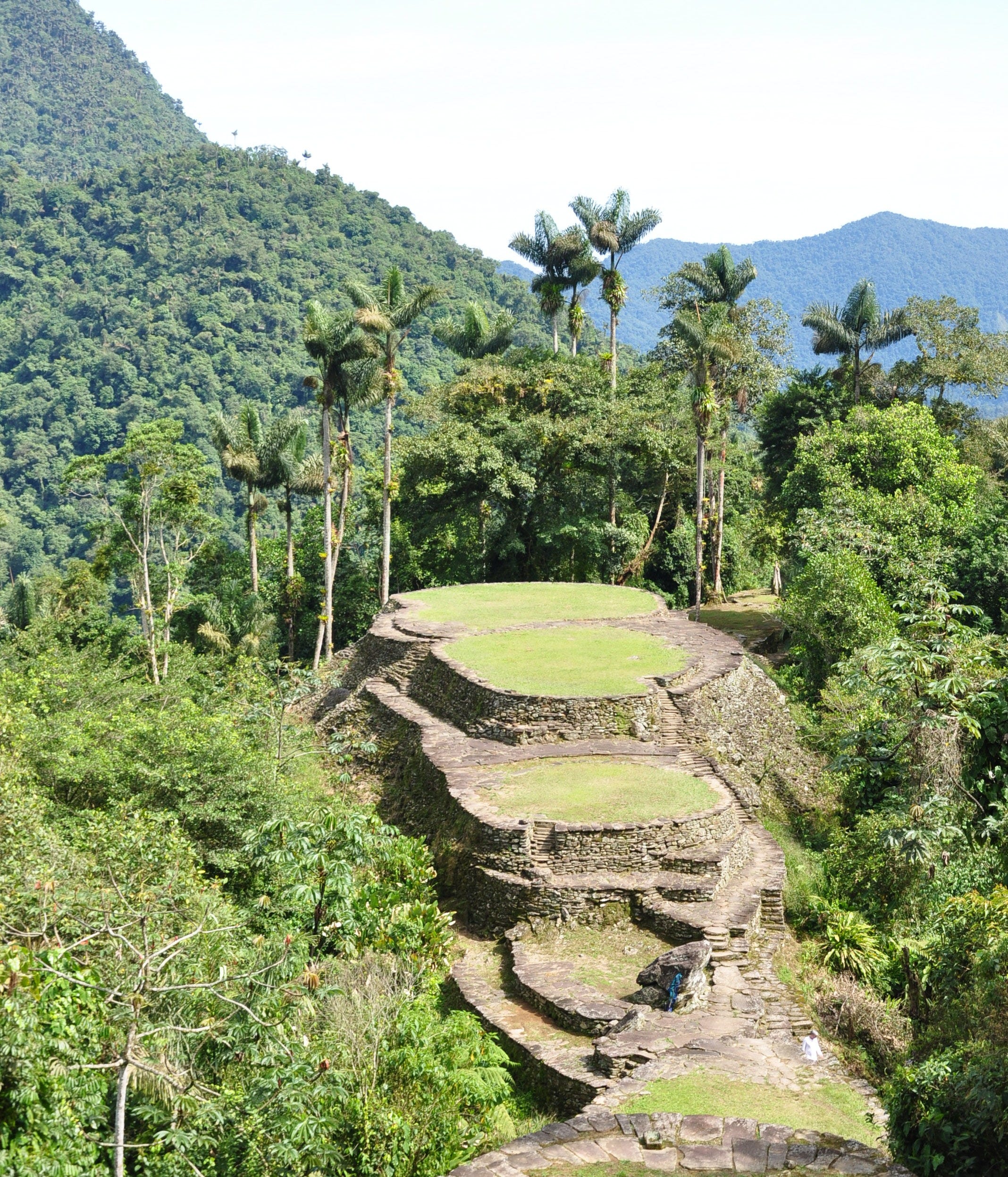
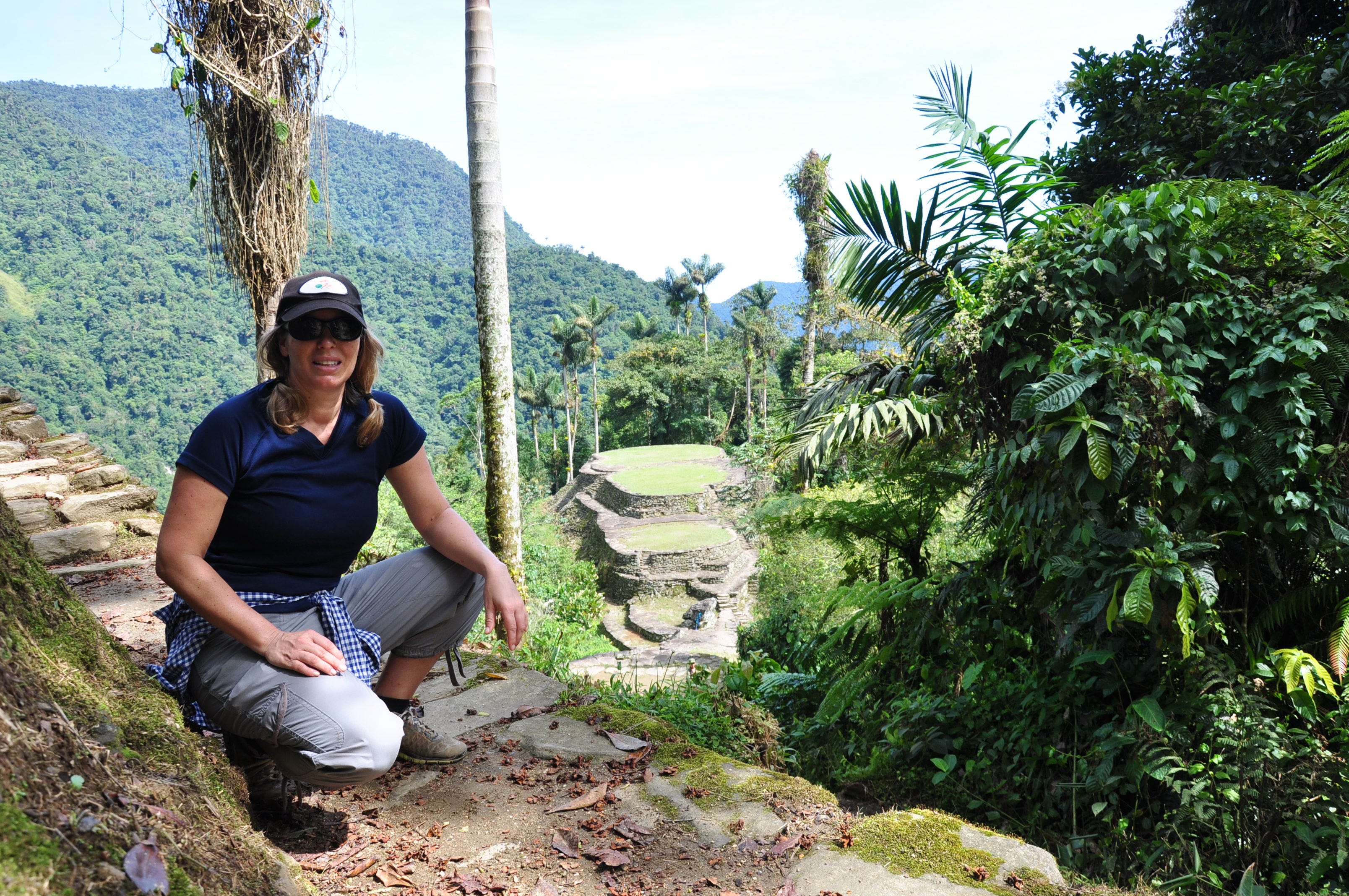
Since then, anthropologists have discovered a tiled network of roads and three central circular plazas, accessed by an entrance atop 1,200 stone stairs. They’ve also found evidence of how the city functioned, with markets, an administrative center, and altars for religious ceremonies. I particularly love the tangibility of Ciudad Perdida. You can truly see that people lived here long ago.
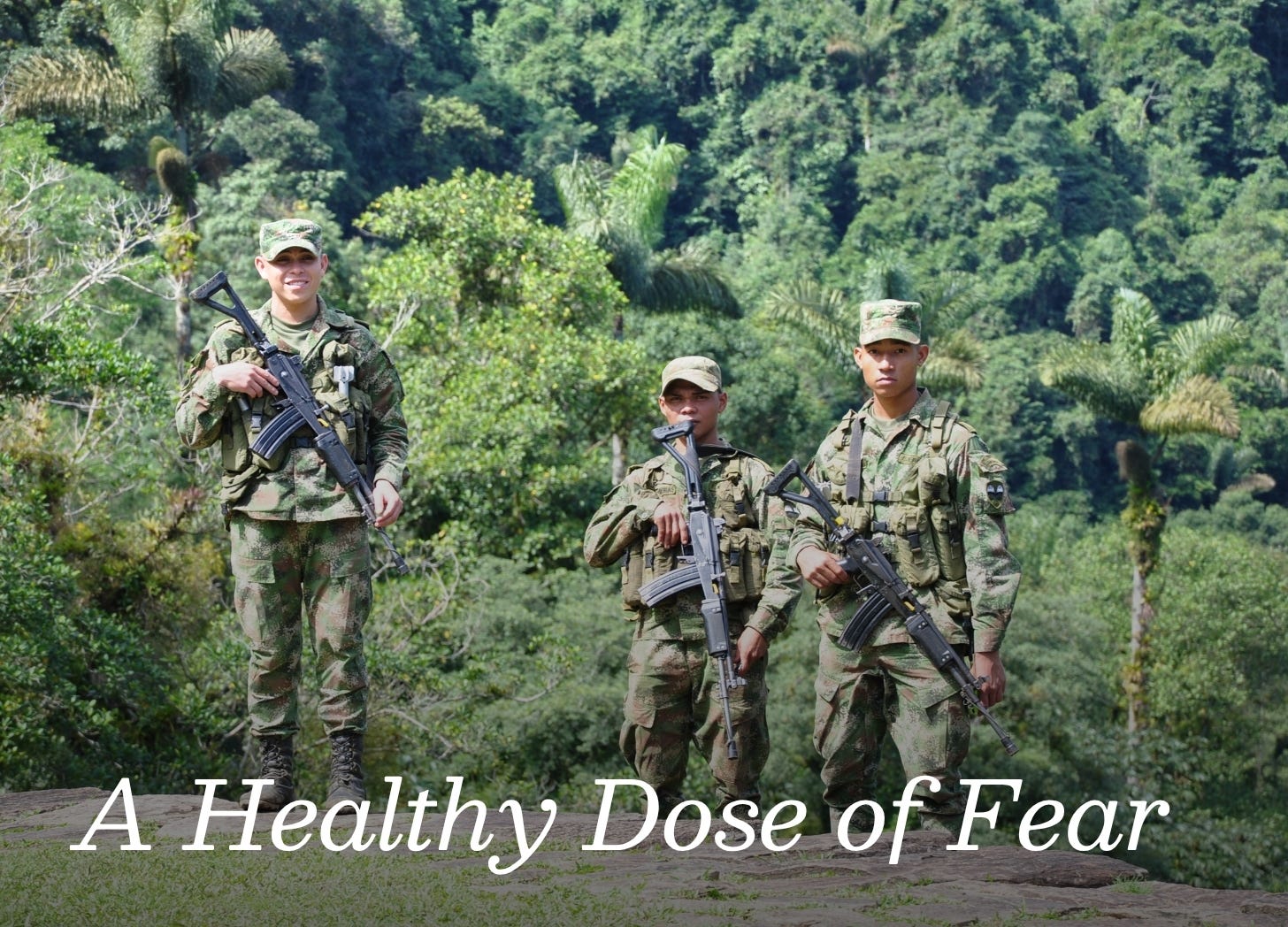
This paradise is anchored by three central terraces that stand out in discs of vibrant green against the surrounding hills of tangled vegetation. Guarded by men in camouflaged fatigues, banana trees, bamboo, and coca plants grow both wild and cultivated throughout the lush jungle landscape.
Guarding Paradise
I greeted the guards with a nod as I walked by, wondering on which side of the conflict they stood. The armed men could have been Colombian government forces, or guerrillas representing the Revolutionary Armed Forces of Colombia (FARC), or the National Liberation Army (ELN). They could also have been a private guard of a coca lord.
I decided not to dwell on the particulars since the situation was entirely out of my hands. I mean, I was already there. If we were to be kidnapped, the men with machine guns would do it. We were at their mercy. I kept my trademark nonchalance towards danger firmly intact.
Jungle Games
The trek included quite a number of river crossings. Some were just small streams where we took off our shoes and scampered across. Others were fairly deep, so we took off our pants (bathing suits underneath) and waded through the thigh-high water.
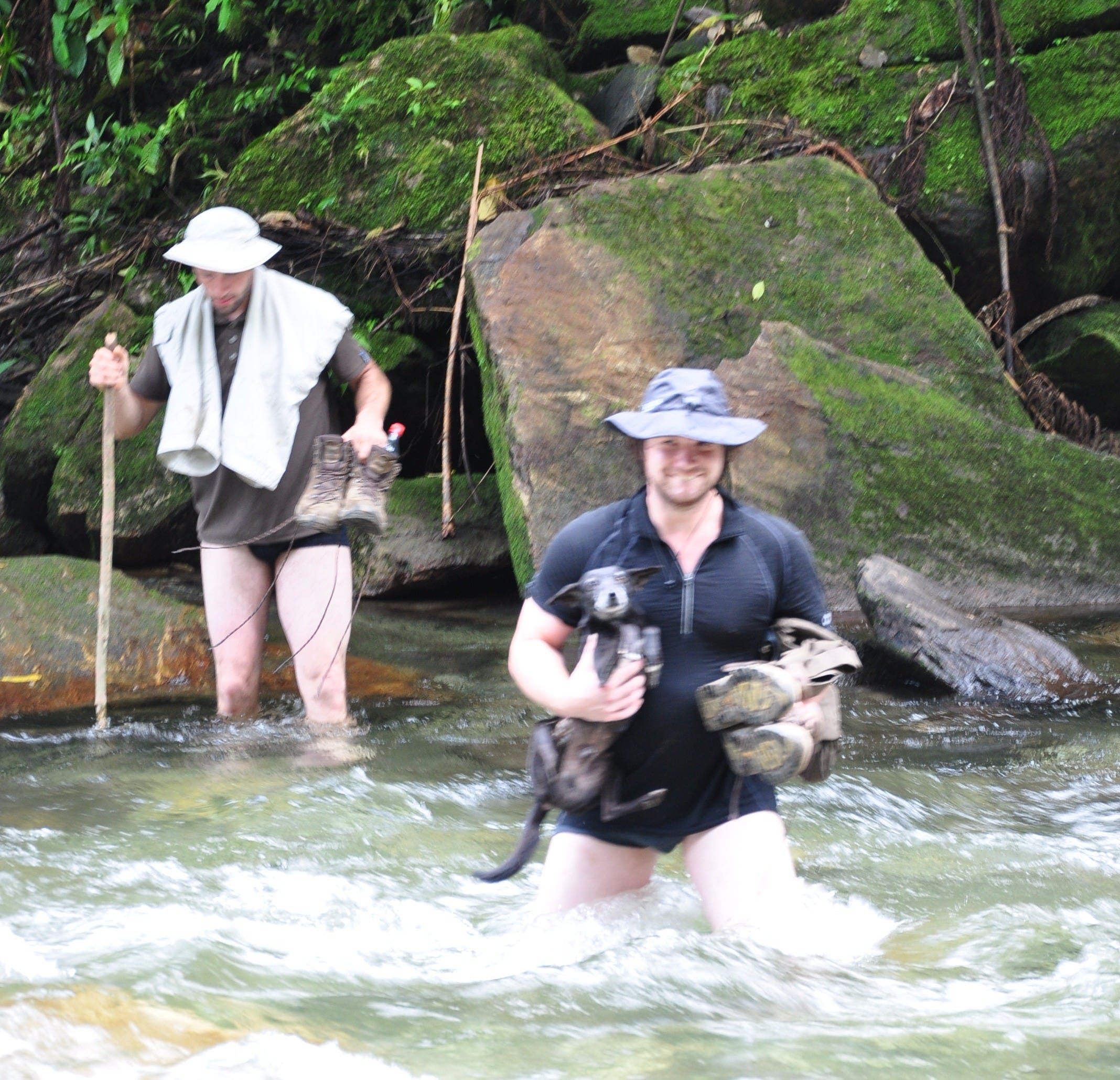
On the return trip home, we were getting lazy and either hitched a ride on the backs of our guides or simply splashed across without bothering to remove our boots. I was actually hiking in sneakers since I’d given my boots away after my Himalayan trek (which didn’t help with all the mud).
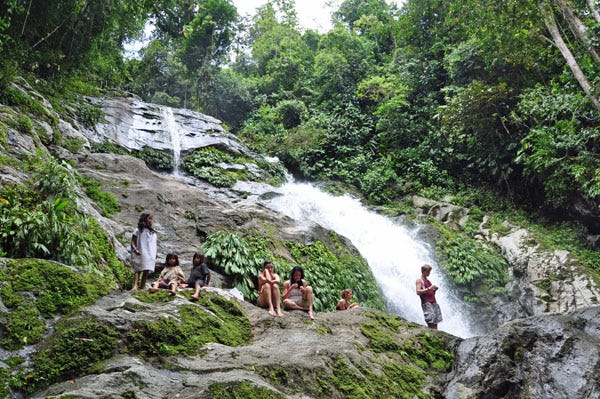
One of the highlights of the trek was at the end of the second day, when we visited a waterfall with several of the local children. The water was spectacularly cool and refreshing after a long walk in the jungle heat. We ripped off our clothes and spent hours jumping off the rocks and swimming around in the crystal-clear water, laughing and playing games.
Encountering the Kogi
Our path also took us through several small indigenous villages. Indigenous Colombians call this area Teyuna, and it’s populated by tribes who believe Ciudad Perdida to be the center of an intricate network of villages. Unlike some, our trekking company was on good terms with the local tribe, the Kogis.
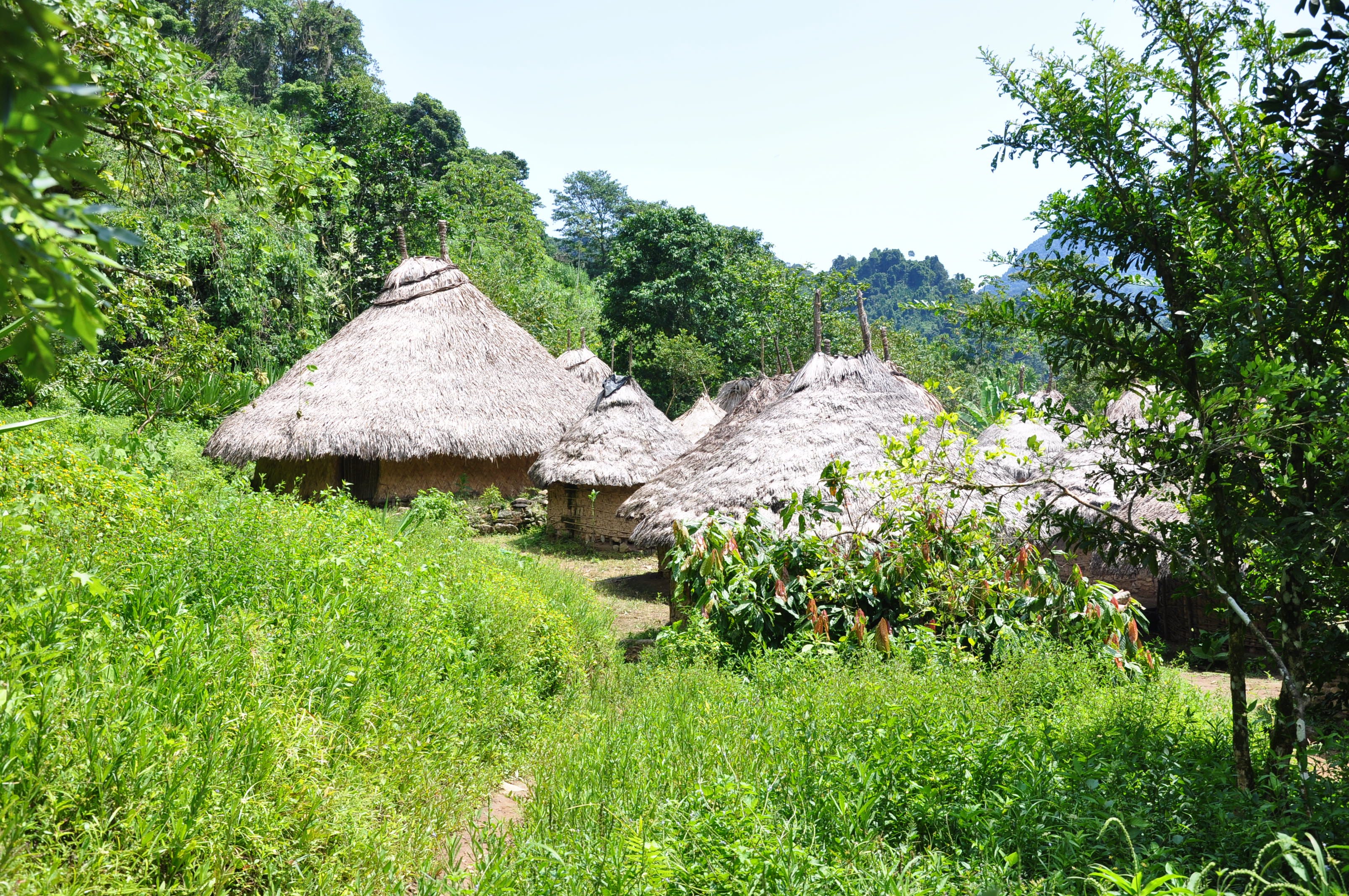
It was fascinating to visit a Kogi village and see their way of life up close. During the day, all Kogi adults are off working in the fields, leaving the smallest children to be looked after by a few older ones. Both Kogi girls and boys have long hair and wear long tunics, so the only way to tell them apart is by the side-slung bag worn by boys and the long beaded necklaces of the girls.
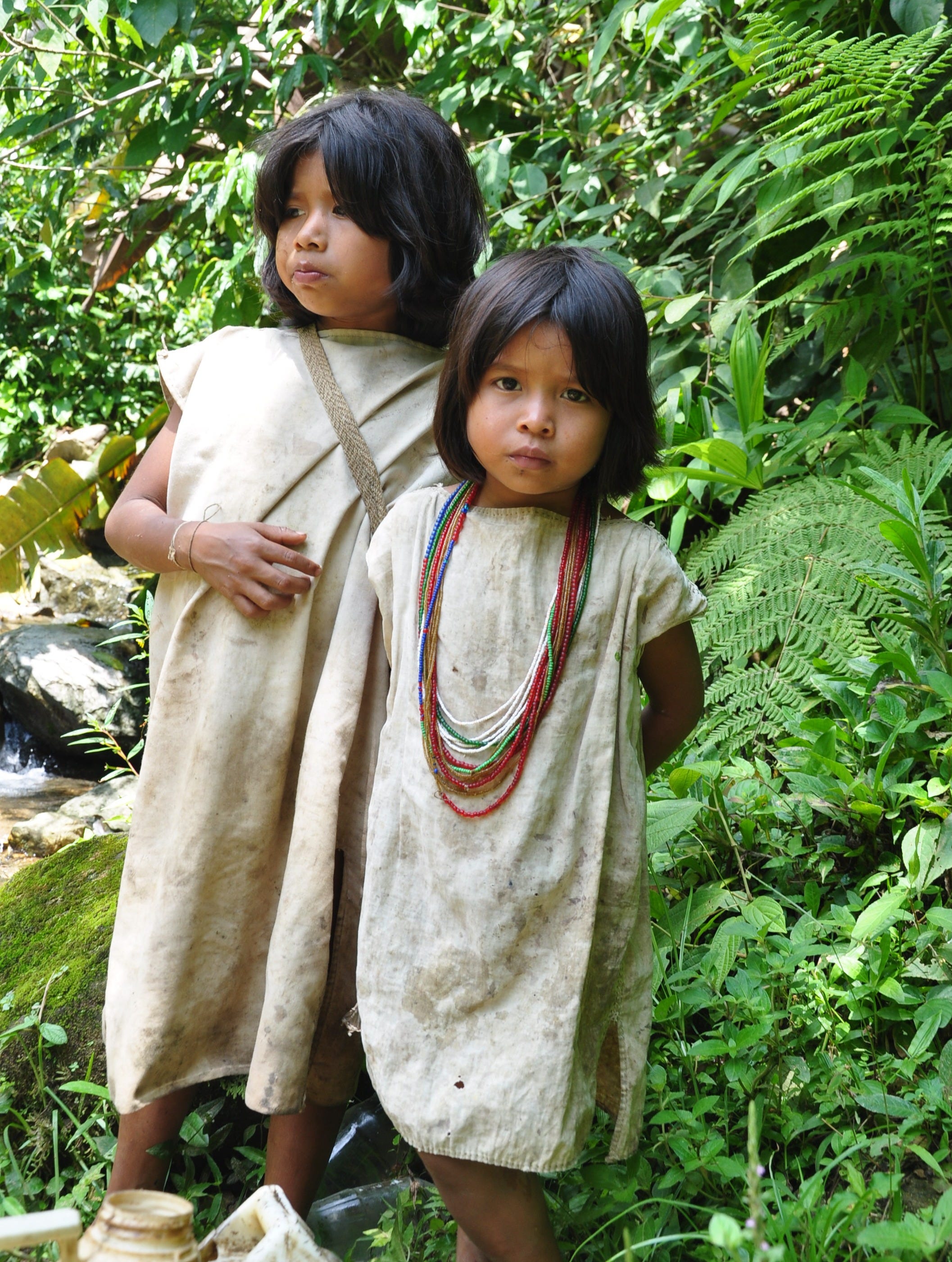
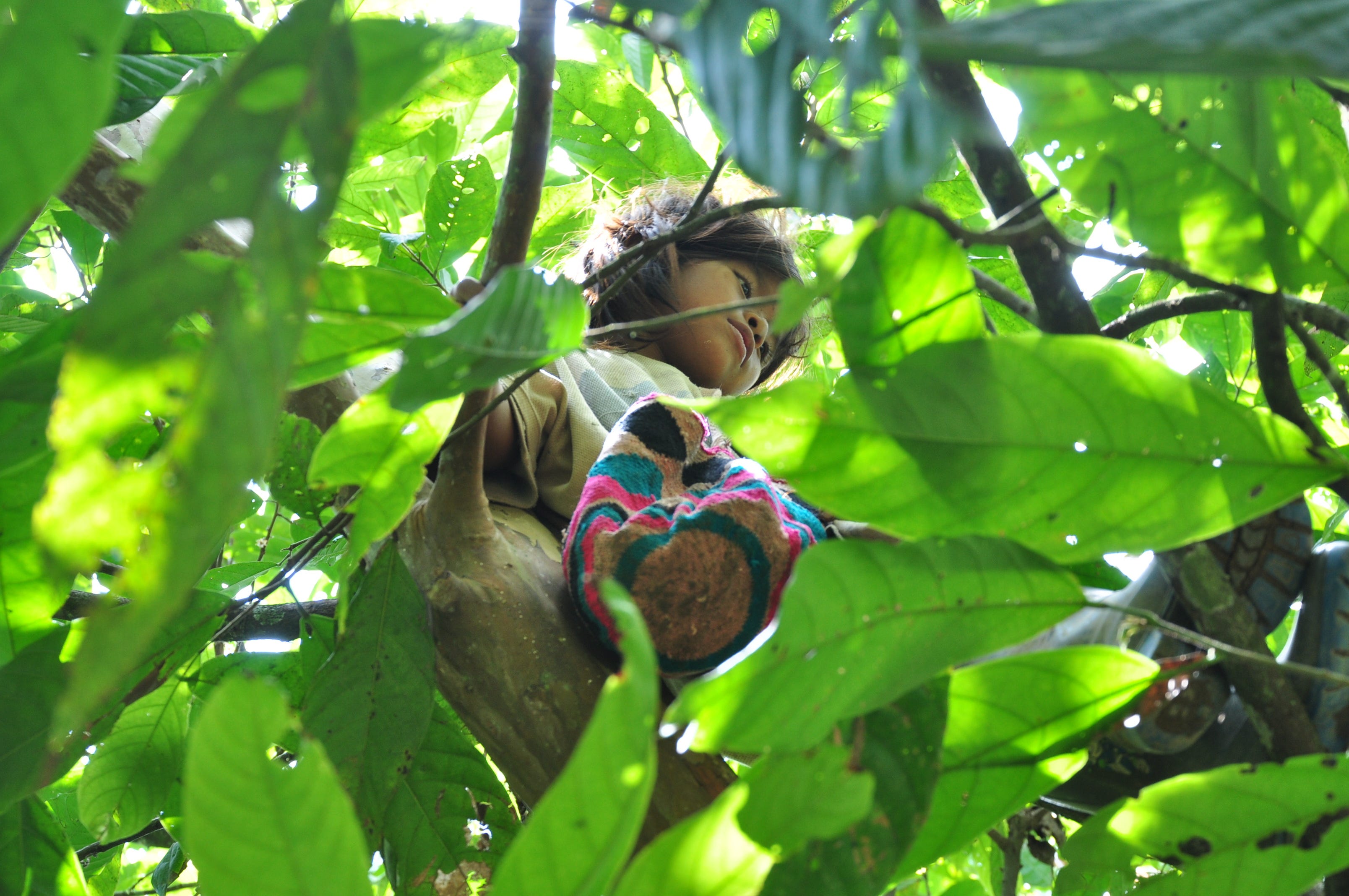
These Kogi kids were full of mischief: playing hide and seek, spying on us, and shyly accepting the small gifts that several of the trekkers brought to share. At night, some of the women would visit our camp to eat with us and sell hand-woven bags.
Earning The View
While I’ve seen my share of ancient lost cities, including Peru’s Machu Picchu, Cambodia’s Angkor Wat, and the Mayan ruins at Tikal in Guatemala, the stark fact that you can only get to Colombia’s Ciudad Perdida via an arduous 5-day hike makes the trip all the more compelling.
Though the trek was immensely satisfying to me, it was not so enjoyable for my mother. See, upon arriving in Taganga, the small seaside town that is the jumping-off point for the hike, I learned that the trek was being closed down for the indigenous full moon ceremonies. Since it would be closed for 2 weeks, if I wanted to go, I had to leave the next day.
This was a no-brainer. That night, I loaded up on a few supplies, including a local black soap that was supposed to keep the mosquitoes at bay, and dashed off an email to my mother letting her know that I was leaving for the trek a few days earlier than expected and I’d be radio silent in the interim. Unfortunately, she didn’t get the email.
This meant that the last message she’d had from me was that I was taking a public bus along the Colombian coast outside the American safe zone, and that I would contact her when I arrived safely. Since she didn’t get my email update, she didn’t hear from me for several days, and she started to worry.
Gradients of Violence
She had good reason to be fearful, since my route took me into the heart of Colombian drug war territory. Two groups of rebels, the FARC and the ELN, have been waging a guerrilla war for more than 40 years. Both groups operated freely in the region, which is widely considered unsafe, and both groups routinely take hostages. During the height of Colombia’s civil war in the 1990s, the FARC alone kidnapped thousands of civilians.
Not all the insurgents were the same. Typically, guerrilla organizations only demand a ransom, while paramilitary groups generally use the practice of hostage-taking as a means of terror or coercion. The most notorious kidnapping of tourists occurred during this same trek to Ciudad Perdida several years earlier, when 8 trekkers were kidnapped by the ELN and held for 101 days.
Following this incident, the trail was shut down for several years but has since reopened, and a few intrepid travelers (like me) have started to trickle back. When I was there in the fall of 2012, the area was experiencing another surge in kidnappings.
So, suffice it to say, Mom had reason to be concerned. And adding to her worry was a new story in the news about 2 foreign women who had been recently kidnapped in that ungovernable corner in Colombia.
Tracking Me Down
So, she turned to the travel spreadsheet and looked up my lodging to try to track me down. Luckily, I’d updated it right before the bus trip. She enlisted the help of her neighbor, a former Spanish teacher, calling the hostel where I was supposedly staying and learned that I had indeed arrived and had set out a day earlier than expected. Mom was relieved, but angry.
The moment I walked back into the hostel, exhausted, muddy, and hungry, I received a message to call my mother. Boy, did I get an earful! I also got an ultimatum that I had heard at least 20 times before―It’s time for you to come home.
But for me, it wasn’t. I was fresh off a fascinating trek to see pre-Colombian sites in the heart of the jungle! I got to meet an indigenous tribe of people I didn’t even know existed! It was exactly the type of adventure I was looking for.
No fear on my end. And, callously, not much sympathy for those back home.
My typical M.O. to disregard fear was ill-informed. Fear helps sharpen our defenses. Fear helps keep us from venturing too deep. Fear helps save us from our own stupidity.
In retrospect, if I could’ve benefitted from one thing during my 2-year trek, it would have been a healthy dose of fear.
🌍 Read More Adventures of a Nomad
If you like this post, please leave a comment or share it with others. This will help more readers find my work. ❤️
Christened “Wander Woman” by National Geographic, Erin Michelson has traveled to 140 countries & all 7 continents. She is a professional speaker and author of the Nomad Life™ series of curated trips and travel guides, including the #1-ranked Explore the World with Nomads.
Want to read more about my adventures? Get the book “Adventures of a Nomad: 30 Inspirational Stories.”
Pushing the envelope but with a treasure at the end, Erin. It looks gorgeous, Cuidad Perdida. Wow, a 5-day hike!
Truly a treasure! Worth the bed bugs I picked up at the jungle camp too! 😝