

🐣 New to nomad life? Advice from the experts.
Nomad Life Community Meetup - June 11, 2026 Recap

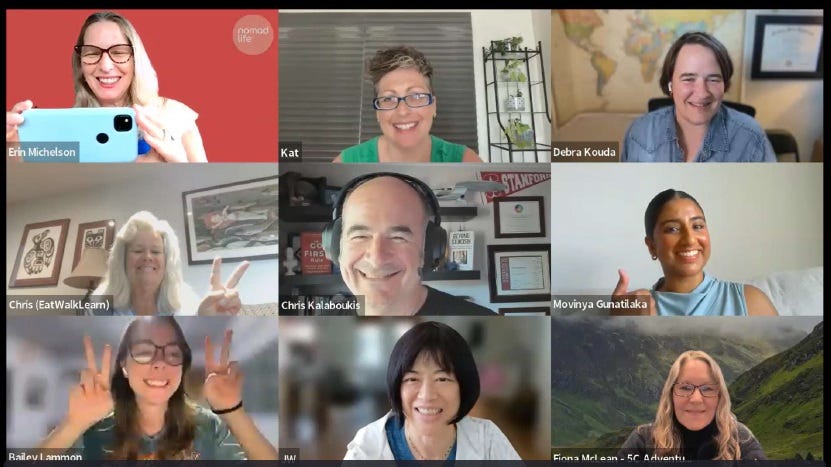
Experience in the House!
🫶 Thank you to our Nomad Life folks for joining the community meetup today, including chris kalaboukis, Chris Englert (EatWalkLearn), Dr. Debra Kouda, Bailey Adventuras, The DigitalHoeMad, Fiona McLean, June from Table Stakes, Jennifer P., and me, Erin, Nomad Life. With a special shoutout to Kat - Fifty & Free for guest co-hosting with me and suggesting the topic: “New to Nomad Life.”
Here’s a call re-cap:
Advice for Aspiring Nomads (Pre-Launch)
Just pick a date and commit. Chris K. emphasized avoiding “paralysis by analysis” — buy the plane ticket, then work backwards. Chris Engler similarly said to “circle a date on the calendar, any date.”
Nomad life is not a vacation. It’s a lifestyle and a marathon, not a sprint. Many people conflate long holidays with nomad life — they’re very different.
Don’t be afraid to seek comfort. Bailey pushed back on the idea that you must rough it. Private rooms, familiar foods, and personal comforts are fine — sustainability matters more than the “experience.”
There’s no one right way. Some have home bases, some roam full-time. Do whatever works for you, and feel free to change it over time.
Don’t over-plan. Erin recommended keeping spontaneity built into your schedule. Pick a region, not a fixed itinerary, and be ready to pivot.
Stay in compatible time zones first. Chris K. advised those with US-based clients to start in South America or Latin America, rather than jumping straight to Asia, to ease the time zone adjustment.
Consider your cultural roots. Visiting countries where you have family or heritage can be a gentler entry point to international living. Same thinking applies to choosing a first country that speaks your native language.
On Managing Expectations & Setbacks
Roll with the punches. Plans rarely survive contact with reality. Resilience matters more than preparation.
If you don’t like a place, leave. There’s no obligation to stay. Erin noted she keeps a fund for any unexpected occurrences, also known as the “silly goose tax” or “nomad tax.”
No expectations are better than fixed expectations. The fun is often in the pivots and unexpected moments.
Destination Recommendations
Georgia (the country) was enthusiastically recommended as a top starter destination — affordable, English-friendly, European feel without European prices or attitude. Note: transportation within the country (minivans/marshrutkas) can be rough.
Seek underrated destinations, not TikTok-famous ones — look for “best country you probably haven’t heard of” lists.
Making a Living on the Road
Remote job + side hustles was the most common model. Chris K. secured a fully remote job and simply started traveling.
Being a nomad is often cheaper than living in the US. Fixed costs like rent and mortgage disappear.
Side hustles like content creation, writing, coaching, and travel agenting can offset expenses and are often tax-deductible as business costs.
Flag Theory was recommended as a strategic framework — looking at where you live, work, incorporate, get healthcare, and invest to optimize taxes and lifestyle. Here’s an article Erin wrote on “Optimizing Travel with Flag Theory.”
Choose FI / FIRE community (chooseFI.com) was recommended by Kat as an excellent resource for financial independence planning that pairs well with nomad life.
Remote Rebellions was metioned as paid community for people seeking remote jobs.
Nomad tax accountants exist — Erin offered to share a contact (Grace) who specializes in non-resident tax consulting and compliance advisory services: GracefullyExpat. You can also read Grace’s Nomad Profile.
Saving on Accommodation
Chris E. shared that she and her husband saved ~$30,000 in one year using six housing strategies (detailed in her YouTube video).
Additional methods discussed:
House/pet sitting via Trusted Housesitters (Fiona had been pet-sitting for ~4 months straight, saving significantly on rent)
WWOOFing (working on organic farms in exchange for room and board)
Workaway / volunteer exchanges — bartering skills for accommodation
Pueblo Ingles / Vaughantown — volunteer programs in Spain where English speakers stay in 4-star hotels in exchange for conversational English practice with Spanish speakers
Building Community on the Road
Easier than you’d think. Bailey said she’d made more friends traveling than she ever expected, even without trying.
Hobbies are the best way to find community. Chris E. recommended joining local meetups for activities you already enjoy (sketching, hiking, dancing) — even with a language barrier, these break you into authentic local community.
Volunteering locally (e.g., staffing a community 5K) is the “secret sauce” for getting past the service-worker English bubble and meeting real locals.
Plan overlap with nomad friends. Erin and Chris E. coordinate with other nomads to align travel schedules and meet up in different cities throughout the year.
Solo vs. partnered travel creates different social dynamics — solo travelers tend to connect more readily with strangers.
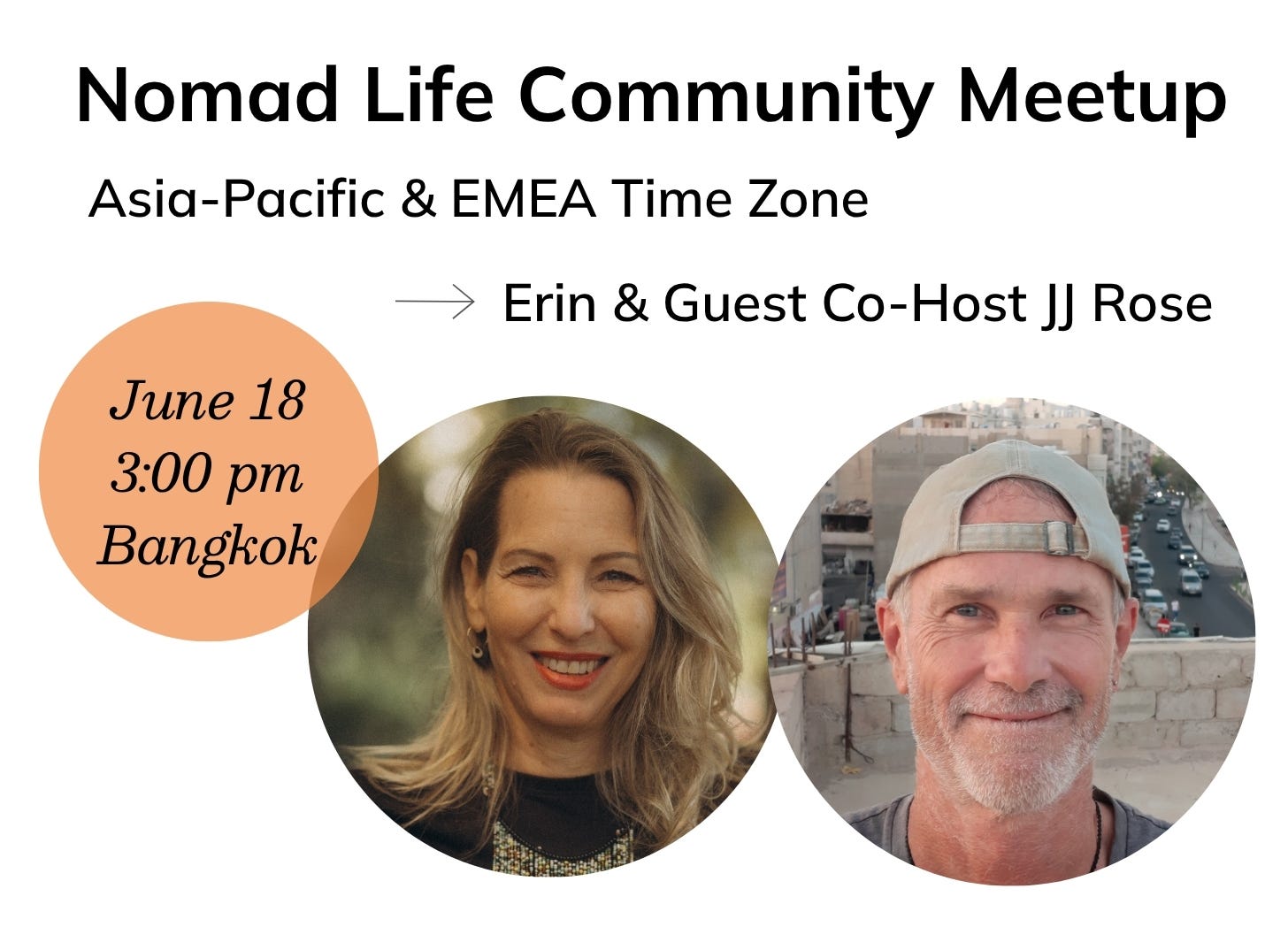
📅 Save the Date: Thursday, June 18 @ 3:00 pm Bangkok – Asia-Pacific & EMEA
● Co-hosted by JJ Rose of Inside the Outside, who chose the topic: “What are the different ways we can connect when travelling?”
📌 AI Alert: I used Claude to summarize our Zoom call. I then edited the transcript.
If you like this post, please leave a comment or share it with others. This will help more readers find my work. ❤️
About Erin: Founder of Nomad Life, Erin was christened “Wander Woman” by National Geographic. She has traveled to 140 countries & all 7 continents. As a professional speaker and author of the Nomad Life™ series, she offers travel safety tips, ethical adventures, and travel guides, including the #1-ranked Explore the World with Nomads.
Thank you! Valuable to read. Hope to make a future zoom call!
Great advice!