

What *Not* to Wear: Arabian Edition
Cultural Delights

Early in my nomad journey, I was in Cairo providing a fundraising workshop. In the class, about half the women were wearing a hijab, a traditional head covering.
For the first several days, I couldn’t tell the women apart from one another. I was accustomed to relying on visual cues, such as hair length, style, and color.
By the end of the week, though, I had retrained myself to look more closely at their faces and notice the differences in their face shape and smiles.
I was reminded of this during my flight from Dubai to Oman last week when I locked eyes with a woman wearing a full face covering. As we looked at one another, we both gave a small nod of acknowledgement.
I sensed that it was important for her, and me too, to see women wearing full-coverage Muslim dress as individuals, and not simply an indistinguishable mass.
These types of exchanges are small moments—but real ones. They are the instances that change how we view one another.
These interactions I hold most dear; when I get the opportunity to really see another person and we give each other the simple honor of acknowledgement.
Lifting the Veil
Derived from the Arabic word for “veil” or “barrier,” the hijab represents a woman’s commitment to modesty and serves as a spiritual, personal, or public expression of faith.
For many Muslim women, wearing full-coverage clothing is not only a sign of modesty and religious devotion, but also part of their cultural identity.
Muslim dress can also be a political statement. For instance, the recent uprising in Iran stemmed (in part) from protests against the wearing of a compulsory hijab.
Here’s an overview of Muslim women’s attire, from least coverage to most:
Hijab: A headscarf that covers the hair and neck.
Shayla: A long scarf wrapped around the head, usually wrapped and pinned. Sometimes part of the face shows.
Abaya: A long, loose-fitting, robe-like garment worn by many Muslim women over their everyday clothing. Typically black, it covers the entire body except for the face, hands, and feet.
Niqab: A veil that covers the face, leaving the area around the eyes clear.
Burka: A one-piece garment covering the entire face (including the eyes) and body, often including hands and feet.
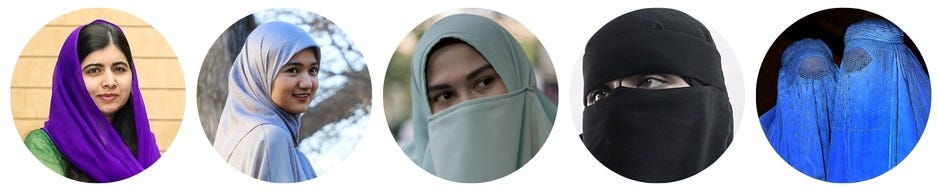
Within these main categories, gradations exist depending on geography, weather, and culture. For instance, a “loose head scarf” shows the face and some hair. An “open abaya” covers the body from the shoulder to the ankle, but is open at the front. The Indonesian jilbab is often brightly colored or patterned.
I found it fascinating in Saudi Arabia to see how women’s dress is changing. In 2019, the government rescinded the law making abayas no longer mandatory. (Note: Before I mistakenly said the law changed in 2026.) While women must “adhere to modest clothing,” I saw the beginning of newfound expression.
While Saudi women predominantly followed the previous law, I saw some women wearing their abayas open, to show their clothing underneath, or belted, to emphasize their waistline. I also saw colorful scarves being worn over the black abayas and more glitzy appliques, such as sequins and lace, decorating their robes.
The transition is fascinating to see.
What Not to Wear
Here I am throughout the years, trying—and mostly failing—to wear modest clothing. It’s hard for a peacock to change its colors.
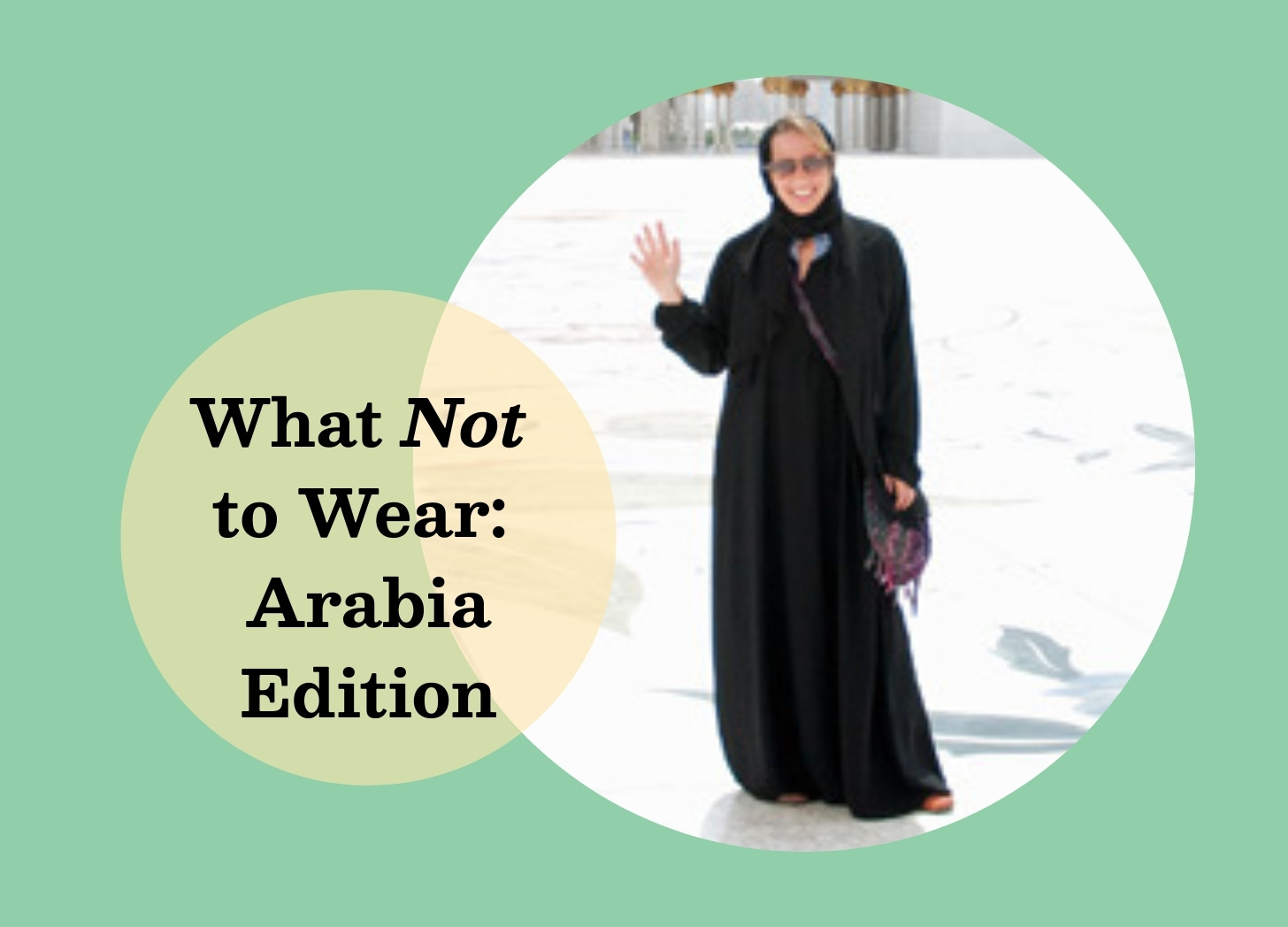
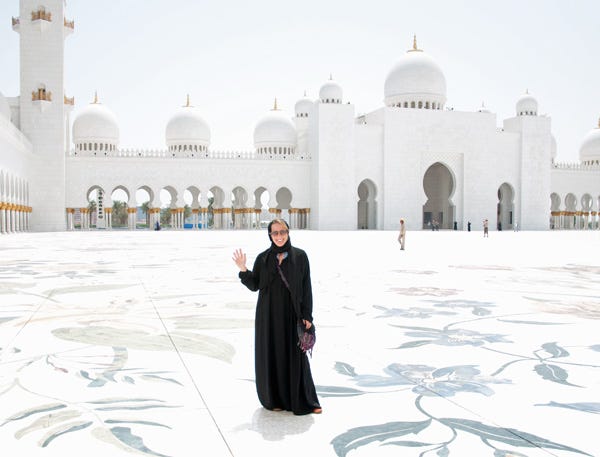
In Abu Dhabi, I wore a full black abaya and head scarf while visiting the famous Sheikh Zayed Grand Mosque. But I’m wearing it incorrectly, as you can see my neck is showing.
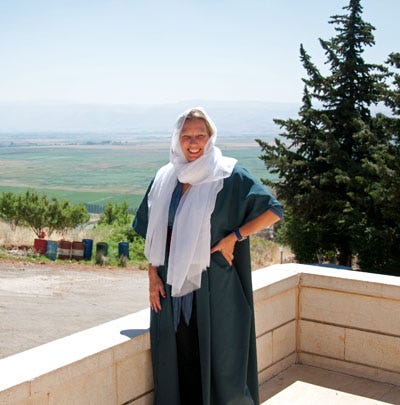
Here I am in Lebanon visiting a Druze Khalwa (house of prayer) in the Bekaa Valley. Again, my whole setup is a little too loose with my neck and arms in view.
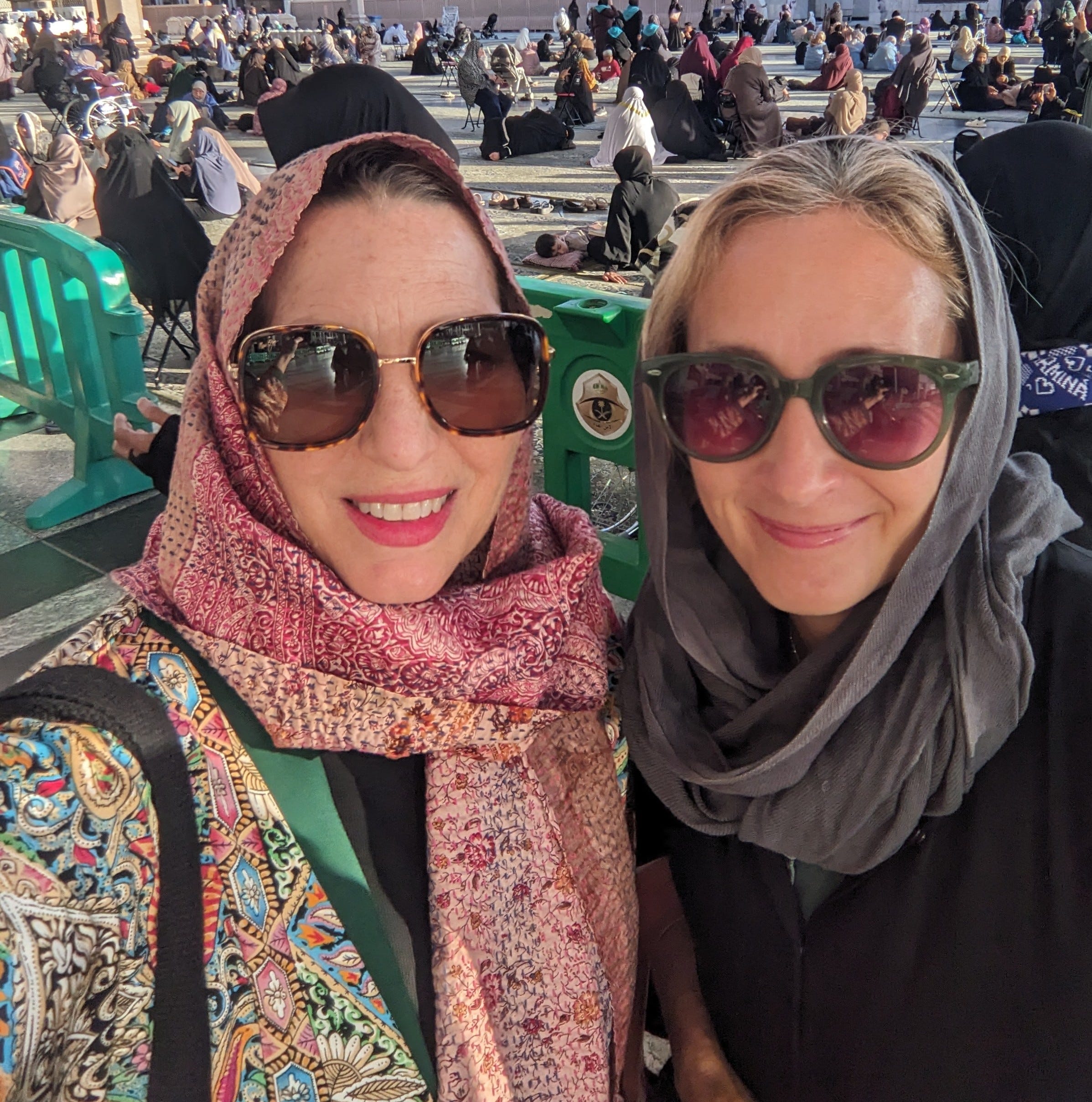
Last month, I visited Saudi Arabia’s Medina, the second most holy site in the world for Muslims (after Mecca, which non-Muslims are not allowed to visit). I’m trying harder here, but my hair is still showing. At least my sunglasses cover half my face.
My friend Larisa is doing better, which is reflected in her more somber tones of grey and black, but she lives in Egypt, so she has the upper hand.
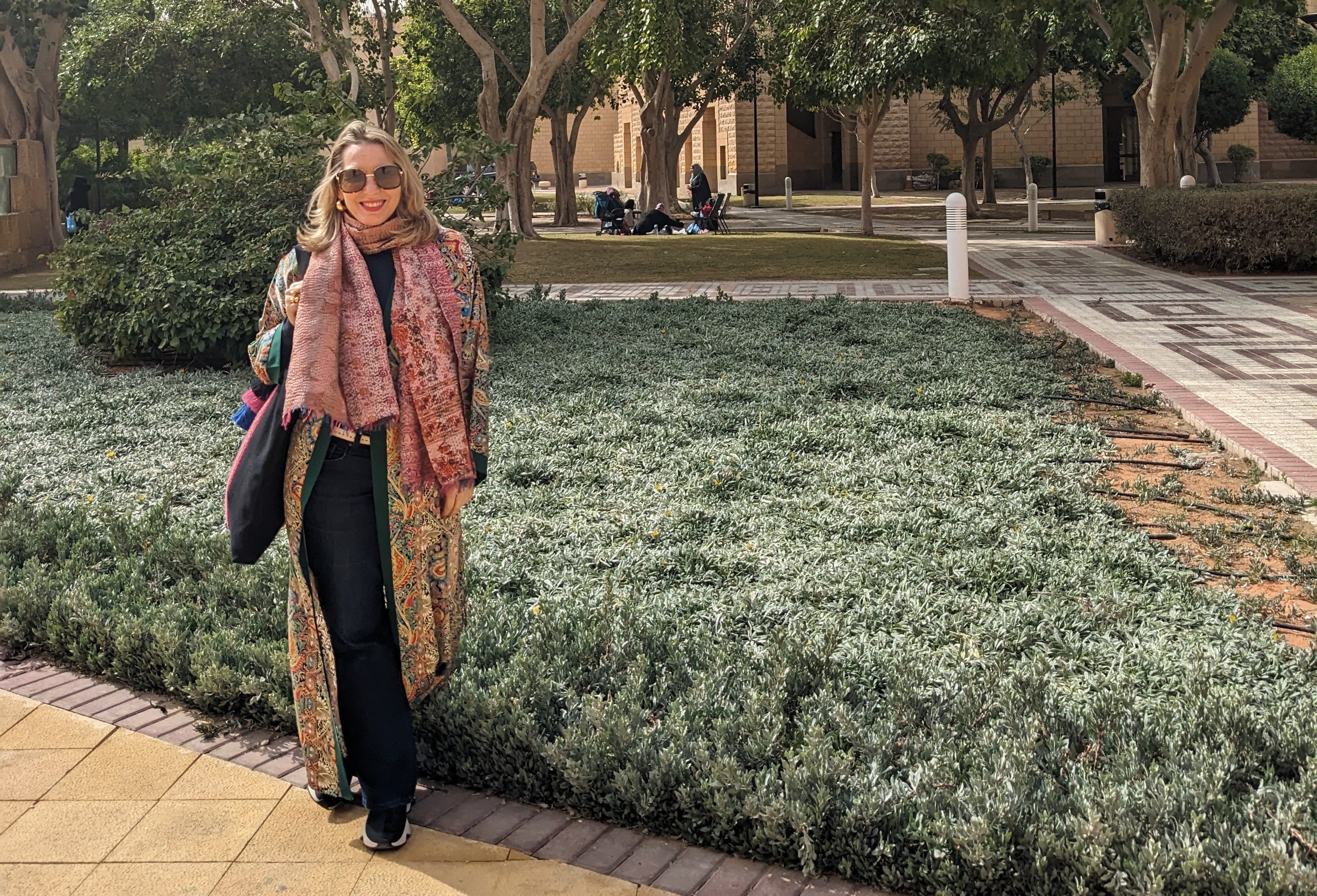
Here I am in Riyadh, the capital of Saudi Arabia. I was going to the museum and definitely not feeling the black aesthetic with my brightly colored scarf and abaya (which I purchased in Uzbekistan last summer).
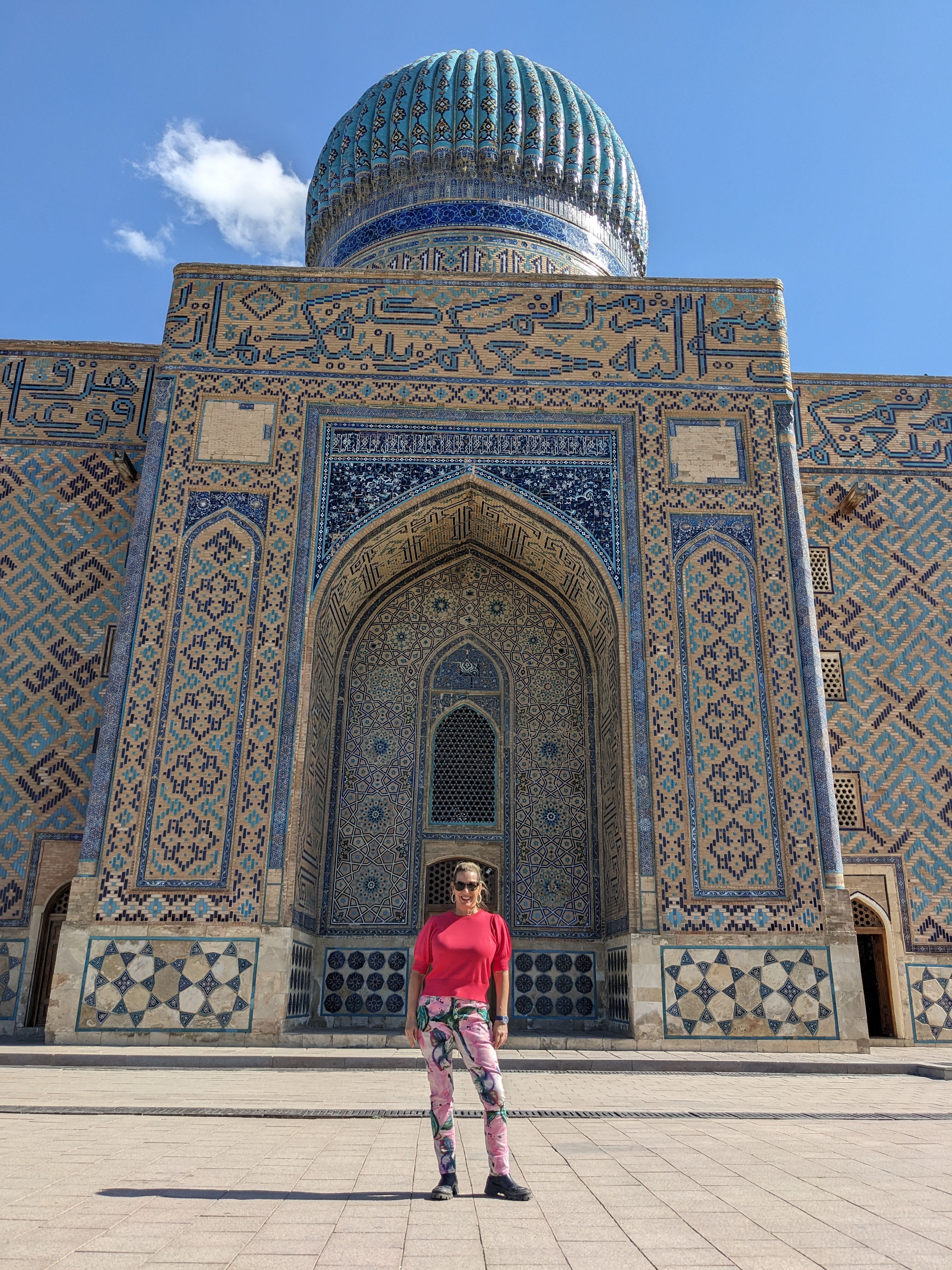
And a total fail in Turkestan, a province in Kazakhstan, last year. Here I was trying to dress modestly, but I think my bright pink sweater and tie-dyed pants wholly missed the mark.
For me, the experimentation with Muslim dress is merely an exercise in trying to be culturally respectful. For many Muslim women—and this is truly the point—they don’t get to make that choice.
If you like this post, please leave a comment or share it with others. This will help more readers find my work. ❤️
Christened “Wander Woman” by National Geographic, Erin Michelson has traveled to 130+ countries & all 7 continents. She is a professional speaker and author of the Nomad Life™ series of curated trips and travel guides, including the #1-ranked Explore the World with Nomads.
Curious to learn more about nomad life? Get the guide “Explore the World with Nomads: 50 Practical Tips, Interviews & Insights.”
We are lucky to have a freedom of choice that is denied to so many women. Thanks for teaching me some of the terminology Erin, and kudos to you for your valiant efforts to respect the cultural norms in the places you visit.
That's so interesting Erin, thanks for sharing in so much detail.
The first question that popped into my mind is.. Do darker colours link to modesty? I have never thought of colour this way.
When I went to Morocco I brought some long skirts that I bought in Thailand and long sleeved blouses which served me well to protect my skin from the sun too. I went to a more remote village with a teacher to his elementary class and I covered up my hair as that is the custom outside of the larger cities.
In Indonesia it was possible to rent a robe to enter the mosque so I did. The rest of the time I just dressed in pants, dresses and t shirts and felt totally comfortable.
But when I flew from Singapore to Malaysia, in the Perhentian islands I was totally unprepared. We were on a beach and there were other visitors wearing the Abaya. I felt very uncomfortable being there in shorts and bathing suits at the same time. It was the beach and it felt very restrictive to think about covering up.