

Most Dangerous Cruise Line
Your Safety & Security at Sea

As a global traveler, I take 1 to 2 cruises a year. I like them for their affordability (when you take into account transportation, lodging, and food, most come in under $100/day), convenience, and, for us nomads, a welcome break from the constant day-to-day decision making that is our life.
Cruising is also considered one of the safest modes of transportation, especially when compared with motorcycle and passenger car travel. Dr. James Fox, a criminology professor at Northeastern University and publisher of the recent report “Floating Felonies: Rape, Assault Surge on Cruises, Darkening Vacation Vibes” (May 17, 2025), states that [while] the rate of violent crime at sea is increasing, it is still about 95% lower than in an average U.S. city.
That said, all cruise lines are not created equal, and several lines perform poorly across multiple metrics. Let’s take a look.

Personal Safety & Sexual Assault
Beginning in 2010, the U.S. Cruise Vessel Security and Safety Act (CVSSA) requires cruise lines to report criminal incidents to the FBI. The Department of Transportation database is public, and quarterly reports are easily accessible.
For instance, the last 4Q25 quarterly report provides a snapshot of the violent crime, including homicide, assault & rape, and theft over $10,000, that was reported at sea on cruise ships during that time period.
The report shows that Royal Caribbean Cruise Line had 16 dangerous incidents last quarter, followed by Norwegian Cruise Lines at 8, and MSC at 7.
In total, 8 cruise lines reported 44 incidents—77% of which are assault, sexual assault, or rape of a crew member or passenger. Again, Royal Caribbean Cruise Lines comes in first in double digits. These results line up with my findings from last spring when I first began tracking this data.
Note: Royal Caribbean is the largest cruise line in terms of passengers (21.2%) and revenue (14.8%), so it follows that they would have the most reported incidents. Accordingly, violent incidents per passenger may not be the highest. Citation: Cruise Market Watch.
In addition, the Rape, Abuse, and Incest National Network contends that 2 of 3 rapes are never reported, so we can assume the number of assaults on ships is exponential. Specific shipboard factors that present an environment ripe for assault include binge drinking (promoted by all-inclusive drink packages), anonymity, and opportunity for sexual predators.
Cleanliness & Sanitation on Board
Your personal safety is also at risk due to poor sanitation on board a ship. The law firm Arnold & Itkin compiled a list of “The 8 Most Dangerous Cruise Line Companies,” sifting through data from the CDC Vessel Sanitation Program.
Per this program, CDC inspectors have the right to unannounced inspections of cruise vessels docked in American ports twice a year. Each inspection examines 8 areas of the ship, from medical facilities to swimming pools, dining rooms to common areas.
Each area’s sanitation is ranked following a weighted scoring system. A perfect score is 100; a score of 86 or higher is satisfactory, a score of 85 or lower is a fail. Again, both the cruise line and the specific vessel’s sanitation record are public.
One interesting finding is that the price of a cruise doesn’t seem to have an impact on its sanitation score. I looked at recent listings on Oceanic, SilverSea and Regent (luxury cruise lines) versus Princess, Carnival and Club Med (budget-friendly cruises) and they all had similarly low scores.
Unfortunately, even with a failing Vessel Sanitation Program (VSP) score, ships can still sail. The only time the VSP will issue a “no-sail recommendation” is if a ship’s condition poses an imminent health risk. Instead, by making the scores public, the VSP hopes market pressure will help keep cruising vessels clean at acceptable levels.
Environmental Polluters
Protection agencies also monitor cruise ships’ adherence to environmental regulations. These regulations, which are not considered especially rigorous to begin with, depend on cruise ship self-reporting any violations of the Clean Water Act.
Recently, the Southeast Alaska Conservation Council (SEACC) surveyed ships’ self-reported data from hundreds of violations. The reports showed excess amounts of unburnt fuel and heavy metals were being dumped into the ocean, impacting not only our health but also the health of the environment. These toxins are especially harmful to marine mammals and our food system.
A March 2026 article by The Alaska Current revealed the biggest offender was Carnival Cruise Lines, parent company of Princess, Holland America, and Carnival. The article notes that “Their ships were responsible for every single one of the 334 violation days in 2024 and 423 violation days in 2023.”
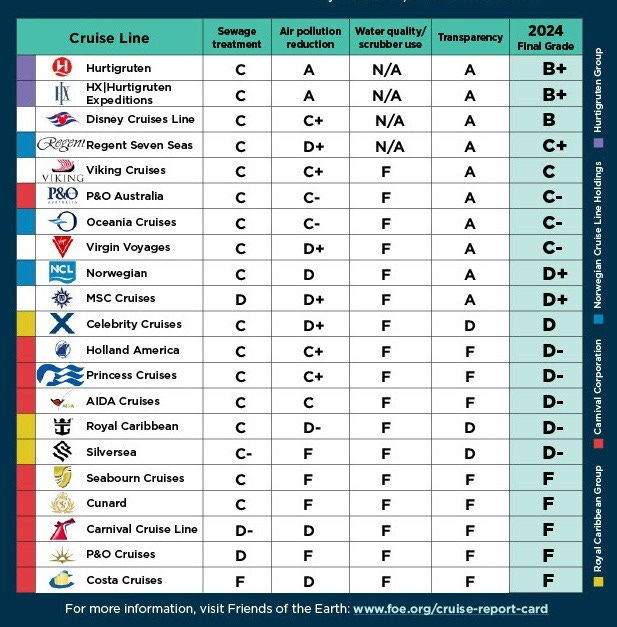
Friends of the Earth Cruise Line Report Cards monitors the environmental impact of cruise lines globally, issuing an environmental report card. The nonprofit organization scored 21 cruise lines, bestowing letter grades A- F.
In their last report (2023):
No cruise line received an A grade
Only 5 of the 21 received a passing grade of C or above
The majority – 62% – received either a D or an F
5 cruise lines received an F grade
Again, the status cruise line Seaborne was given an F, the same as the budget line Carnival. So while we passengers may be paying more for the cruise, these dollars are not translated into safer environmental protections.
Taking A Stand
As a full-time traveler and someone who enjoys cruising, I was dismayed to see these results. Especially since personal safety and environmental protection are two areas that I care about deeply.
When thinking about writing this post, I was prepared to take a stand and boycott the largest offender. But as I look more closely at infractions across the board, there doesn’t seem to be one boogie-man. Instead, most cruise lines perform poorly across all areas of safety and protection.
As a person committed to ethical travel, I will continue to monitor the overall rankings of different lines, weighing the infractions, and deciding on the ship and line before booking each cruise.
This is not something I particularly want to do, but I feel it’s important to make an informed decision. And use this opportunity to leverage my tourist dollars to press for greater adherence to the safety protocols that are in place. I encourage you to do the same.
If you like this post, please leave a comment or share it with others. This will help more readers find my work. ❤️
Christened “Wander Woman” by National Geographic, Erin Michelson has traveled to 130+ countries & all 7 continents. She is a professional speaker and author of the Nomad Life™ series of curated trips and travel guides, including the #1-ranked Explore the World with Nomads.
Curious to learn more about nomad life? Get the guide “Explore the World with Nomads: 50 Practical Tips, Interviews & Insights.”
This is incredibly disturbing. The fact that you have basically no rights when you’re at sea is equally scary. Thanks for your reporting here, we need more of this and more accountability on behalf of the cruise lines
I’ve never been a cruise person.
My first time on one was… bad. I was throwing up every single day for all seven days at sea. Safe to say, I do not have sea legs.
I did brave the seas again a few years later for a very short trip—for personal reasons I mentioned in a previous post—but I’m not going all in on cruising just yet. I’m more open to it now than before… just haven’t taken that next step.
What’s interesting is that at work, as a travel publisher, we push a lot of cruise packages… and they keep selling.
I’m always a little surprised by how many people are willing to drop $3k, $10k, even $20k per person on a cruise.
Which makes me think: this isn’t going anywhere.
If anything, cruising is only going to become more widespread.
I just hope it can evolve to become more sustainable—because if this is the direction travel is heading, the planet is going to need it to.